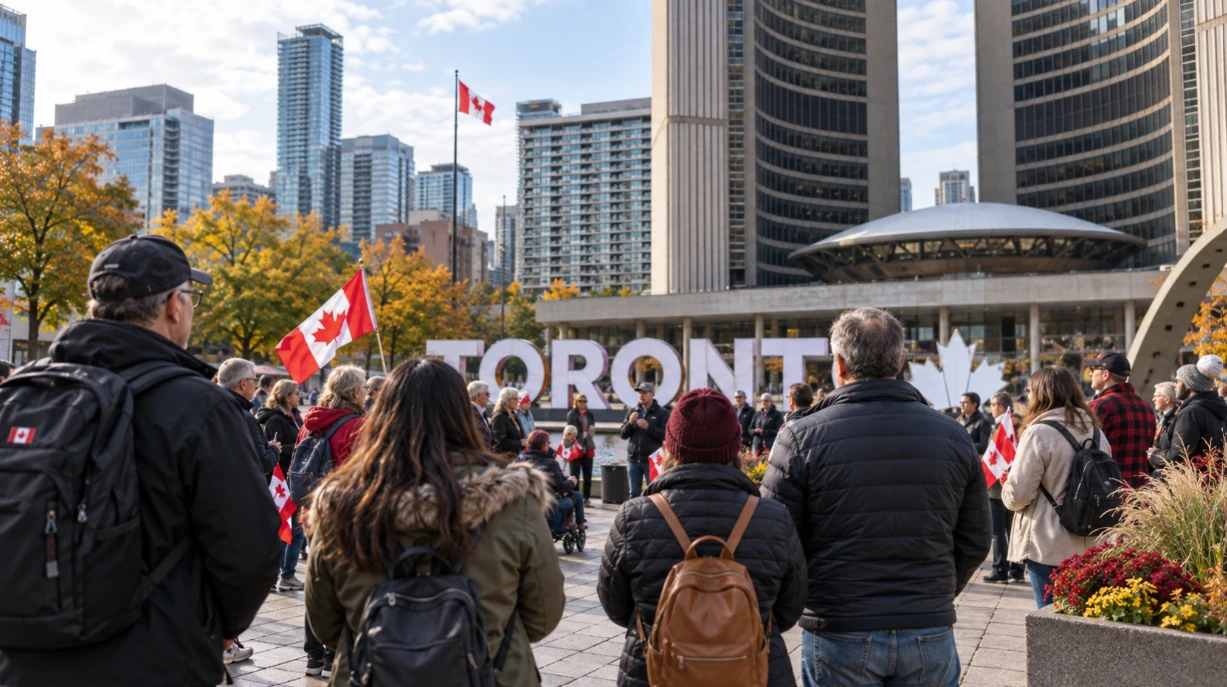
There is something immediately recognisable about people sharing a square: the smaller conversations inside a larger scene, the pause to listen, the sense that a concern has become public.
That first impression can invite useful questions. What has brought people together? Is this a celebration, an organised campaign, a meeting or an ordinary day in a busy place? Who is speaking, and where can their purpose be checked? This guide offers a way to explore Toronto’s community life without asking a single image to answer everything.
First, understand the place in the picture.
Nathan Phillips Square sits outside Toronto City Hall. The City describes it as a public gathering place and provides information about community and City-led events there. The square is one useful setting for thinking about public life: a shared location can accommodate different activities, audiences and purposes.
Official sourceCity of Toronto — Nathan Phillips Square
Recognising a setting does not identify the people in an image or establish what they believe. A flag, a camera or a large group cannot, on its own, tell us the name of an event. The scenes throughout this publication are editorial illustrations. They give the articles a Toronto setting; they are not our eyewitness record of a particular gathering.
When reading an actual event report, look for the details that connect the place to the account: an identified source, a date, the organiser’s stated purpose and reporting that explains what happened. Keep what is visible separate from what has been independently confirmed.
01 / A movement is more than a moment.
It helps to distinguish three ideas. A public gathering is an occasion when people come together. A community movement suggests activity organised around a shared concern over time. A formal consultation is a defined process for seeking input on a proposal or project. These descriptions can overlap, but they do not mean the same thing.
A gathering may be the most visible part of an ongoing initiative. It may also be a one-off event with no wider campaign behind it. Ask how the organisers describe the activity, what they are asking people to do and where a reader can learn about the work before and after the occasion. Avoid assuming that everyone present shares an identical view.
Useful questions are concrete: what concern is being discussed, who has set the agenda, whose experience is represented and what would count as a next step? They make room for curiosity while leaving the reader free to decide whether, and how, to take part.
02 / Look beyond the largest gathering.
Community participation does not need a city-wide stage. Toronto’s community-initiatives resources describe support for resident-led activity, including information about community space and local development. These resources are a starting point for finding an appropriate contact; they are not a promise that a particular group will receive support.
Official sourceCity of Toronto — community initiatives
Smaller settings can offer a different way into a subject. Toronto Public Library’s events directory includes civic and community engagement, conversation circles and other learning activities. Readers can search by location, audience, date and category, then check an individual listing for its format and registration details.
Official sourceToronto Public Library — events directory
The practical question is where you would feel able to listen and ask something useful. You might prefer a structured discussion, a local activity or simply time to read the background. Attendance is only one way to become better informed.
03 / Match the question to a participation route.
If the subject concerns a City project, begin with the relevant page on Have Your Say Toronto. The City’s engagement platform distinguishes projects and stages of consultation. Check what the process is asking about, how input is being received and whether the opportunity is still open before treating an old notice as an invitation.
Official sourceCity of Toronto — Have Your Say Toronto
Council and committee business follows a different route. The City explains how to submit written comments on an agenda item and how to request to speak at a committee or board. Full Council does not generally hear public speakers, except where legislation requires it. Read the current instructions rather than assuming that every meeting offers the same opportunity.
Official sourceCity of Toronto — having your say at Council and committee meetings
Review the associated privacy notice as well. Written comments, names and committee presentations become part of the public record, and speakers appear in live and archived video. Consider what you share directly with the responsible service. This publication provides links, not a submission or registration service.
04 / Give the notice as much attention as the image.
Before attending a gathering, find the organiser’s current notice. Check the date, precise meeting point, format, registration arrangements and any stated accessibility information. If something you need is missing, ask the named organiser before making plans. An appealing image is not a schedule.
The City publishes an events schedule for Nathan Phillips Square and directs readers to organisers for details. It is a useful reference, not proof of what every person in the square is doing. A missing listing, by itself, also does not establish that a gathering did not happen.
Official sourceCity of Toronto — events happening at Nathan Phillips Square
Illustrative community scenario
A conversation with somewhere to go.
Imagine neighbours discussing how a nearby park could feel more welcoming. One person reads the background, another checks the appropriate City contact, and others describe how they use the space. They agree to write down their questions and arrange a further discussion. This is an illustration of a possible process, not a report of an existing group, approved project or promised outcome.
Follow the quieter work that comes afterwards.
When the gathering ends, separate three notes: what you directly observed, what someone said and what remains to be checked. A stated ambition is different from a recorded decision. Look for a published update, a meeting record or the next notice before repeating a claim about what changed.
You can keep the next step modest: read a source, ask a question, share accurate information or explore a local activity. The aim is to understand the conversation well enough to choose your own place in it. Our six-step checklist helps organise a visit without collecting names, attendance details or personal notes.
Prepare with the before-you-go checklist ↗